
Could Your Shoes Be Causing Your Pain?
When your knee hurts, you think about your knee.
When your hip hurts, you think about your hip.
When your back hurts, you think about your back.
But how often do you think about what you're standing in all day?
A new documentary called Stupid Shoes is asking exactly that question.
The film investigates something most of us rarely consider: could the shoes we wear every day be changing the way our feet function — and could that affect the way the rest of our body moves?
It’s an interesting question because your feet aren't separate from the rest of you.
They are where you meet the ground with every single step.
Your feet are doing more work than you realise
Think about how many thousands of steps you take during a normal day.
Every time your foot hits the floor, your body has to manage force, adapt to the ground and move that force upwards through your ankle, knee, hip and beyond.
And no two people do this in exactly the same way.
Some people put more pressure through one side of their foot.
Some load one leg differently from the other.
Some have reduced movement through a particular joint.
Some feet roll in or out more than others.
And sometimes the shoes we put around those feet can influence what happens next.
That doesn't mean that your trainers are automatically responsible for your knee pain or that changing shoes will magically cure your back.
The body is much more complicated than that.
But footwear is absolutely worth considering as part of the bigger picture.
The problem with choosing shoes purely by how they look
Most of us buy shoes based on three things:
Do I like them?
Are they comfortable when I first put them on?
Are they the right price?
What we don't normally ask is:
Are they right for the way I move?
A shoe can feel beautifully soft when you first put it on and still be poorly suited to your foot or the activity you're using it for.
It may be too narrow.
It may restrict your toes.
It may change how your foot moves.
It may be too flexible or too stiff for what you need.
Or it simply might not work particularly well with your biomechanics.
And when you repeat that movement thousands of times every day, small things can start to matter.
Could your shoes be contributing to your problem?
Possibly.
Especially if you notice things such as:
aching feet after walking or standing
heel or arch discomfort
recurring ankle problems
pain that appears during longer walks or runs
knees that become uncomfortable with activity
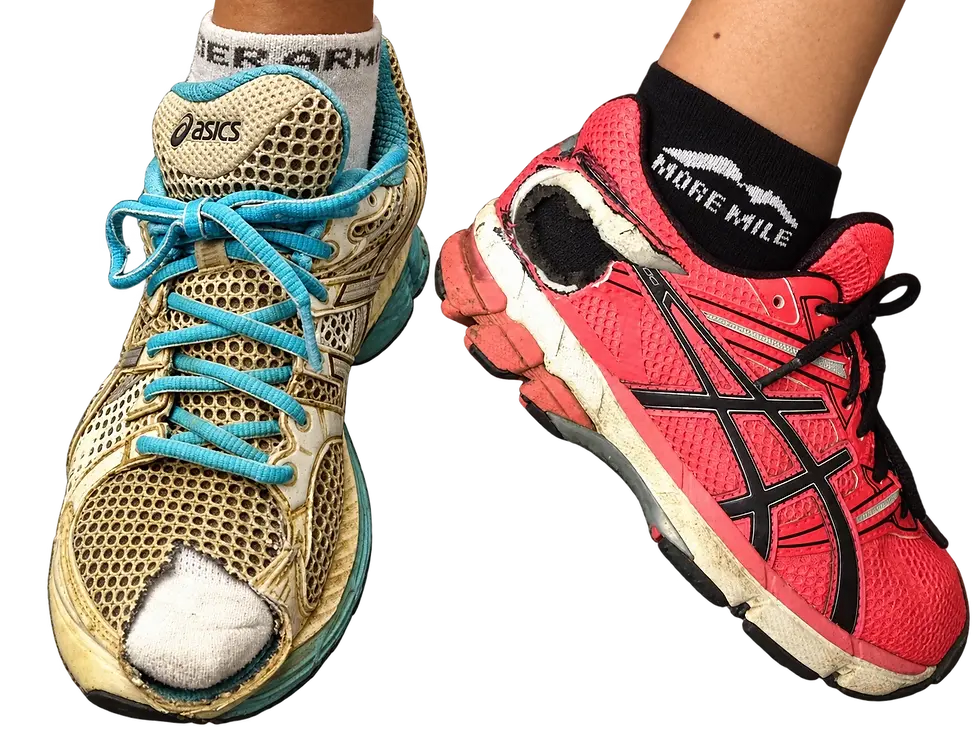
one shoe wearing differently from the other
feeling much better as soon as you take your shoes off
repeatedly buying new trainers hoping the next pair will solve the problem
The important word here is contributing.
Pain rarely has one simple cause.
At Active Therapy Clinic, we're much more interested in understanding why your body is struggling with the demands you're putting on it than simply blaming one structure.
And that means sometimes looking all the way down to the ground.
Before buying another pair of shoes, look at how you actually move
This is where things become much more useful.
Instead of guessing whether you need more cushioning, more support, a different brand or another £150 pair of trainers, we can look at what's actually happening when you stand and walk.
Our Footscan assessment allows us to see how pressure travels underneath your feet as you move.
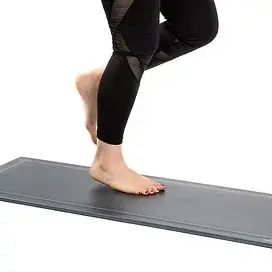
That can help us identify differences in loading, timing and movement that aren't obvious just by looking at the outside of your shoe.
More importantly, we can combine that information with your symptoms, your movement, your strength, your activity and what you're trying to get back to.
Because the goal isn't to produce an impressive-looking scan.
The goal is to help you move better.
Where PHITs orthotics can help
For some people, changing footwear is enough.
For others, rehabilitation and strengthening are the priority.
And for some, adding personalised support inside the shoe can make a meaningful difference.
That's where PHITs orthotics may come in.
Rather than thinking of an orthotic as simply an "arch support", think of it as a way of changing the relationship between your foot, the ground and your shoe.
When appropriate, we can use the information from your assessment to create support tailored to the way you move.
But the important bit isn't how the orthotic is manufactured.
It's what we're trying to achieve for you.
That might mean being able to walk further without thinking about your feet.
It might mean getting through a working day with less discomfort.
It might mean making running feel easier again.
It might mean reducing irritation while we strengthen an injured area.
Or it could simply mean feeling more comfortable and confident every time you put your shoes on.
That's the benefit.
An orthotic is only as useful as the shoe you put it in
This is the part that's often missed.
You can have excellent support underneath your foot, but if you put it inside a shoe that doesn't suit you, you're potentially fighting against it.
That's why we don't believe the conversation should simply be:
"You need orthotics."
It should be:
What does your foot need?
What does your activity demand?
What shoe gives your foot the right environment?
And would additional support improve that combination?
When those pieces work together, you've got a much better foundation to move from.
The "best shoe" doesn't exist
People regularly ask us:
"What's the best trainer?"
Unfortunately, there isn't one.
The best shoe for your friend, running partner or favourite athlete isn't automatically the best shoe for you.
Your feet are different.
Your movement is different.
Your injury history is different.
And what you ask your shoes to do might be completely different.
Someone standing on a hospital ward for 12 hours has different requirements from someone training for a marathon.
A golfer has different footwear demands from a footballer.
And someone recovering from an injury may temporarily need something different again.
That's why personalised advice is so much more useful than simply buying whichever trainer has the best reviews.
Sometimes the answer isn't more support
There's another important point.
Not everyone needs an orthotic.
Sometimes what your feet need is improved strength.
Sometimes they need more movement.
Sometimes we need to change training load.
Sometimes the solution is simply a more appropriate shoe.
And sometimes an orthotic can be used alongside rehabilitation to help you stay comfortable and active while we work on the bigger picture.
Good treatment isn't about selling everyone the same solution.
It's about working out what is most likely to help you.
So, are your shoes causing your problem?
Maybe.
Maybe they're contributing to it.
Maybe they're exposing something else.
Or maybe they're completely innocent.
But if you've been dealing with recurring foot, ankle, knee, hip or lower-limb discomfort, they're certainly worth considering.
Rather than buying another pair and hoping for the best, we can investigate how your feet are interacting with the ground and help you understand what your body might actually need.
Because sometimes the problem isn't simply where it hurts.
It can start with what happens at your very first point of contact with the ground.
Want to find out what's happening underneath your feet?
At Active Therapy Clinic, we can assess how you stand, walk and load your feet and discuss whether your footwear, rehabilitation, PHITs orthotics — or a combination of these — could help you move more comfortably.
The goal isn't to sell you an insole.
The goal is to help you get back to walking, working, exercising and doing the things you enjoy with less thought about your feet and more confidence in your movement.
Book an assessment today call 01285 643080with Active Therapy Clinic and let's find out what your feet have been trying to telou.


Comments